

Enterprise IT infrastructure / traffic distribution and service entry
Server load balancing
An enterprise needs a distribution entry that sends requests to available backend services, avoids concentrating all pressure on one backend, and leaves a clear path for maintenance, growth and fault handling.
The server-room equipment is context; the focus is the entry, service pool and maintenance path.
01 Why a distribution entry is needed
Do not make one backend carry every request
Traffic growth, planned maintenance and temporary faults all increase pressure on a single backend. Load balancing puts the entry, policy, health state and service pool into one work chain so requests have a place to enter, backends can be adjusted and maintenance has an executable window.
Unified entry
Send external requests to the distribution entry first, then to available services by confirmed policy instead of pressing every request onto one backend.
Maintenance can be scheduled
When a backend needs maintenance or expansion, adjust the service pool step by step using health state and a change window rather than relying on memory.
Faults have boundaries
When health checks find an abnormal node, temporarily remove it from the available pool; return it only after validation, with the process tested within scope.
02 How the architecture works
From clients to a healthy service pool
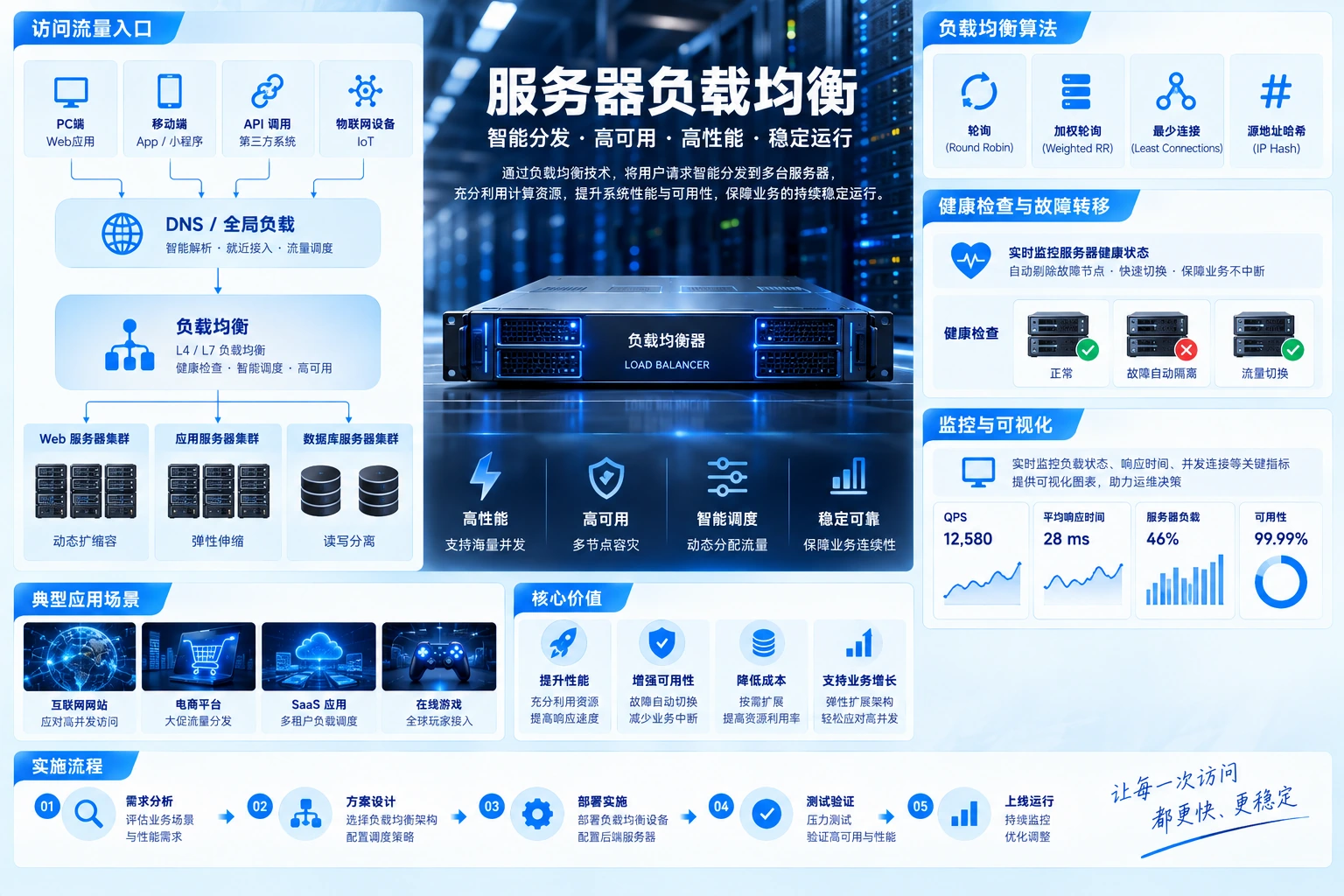
Traffic enters a redundant load-balancing entry and reaches the backend pool through confirmed L4 / L7 policy. Health checks observe node state separately; an abnormal node exits temporarily and returns after recovery and validation.
Client requests connect to a redundant load-balancing entry, which distributes traffic by policy to three backend nodes. Independent health checks observe node state; an unhealthy node leaves the pool temporarily and rejoins after recovery.
- AService node 01Healthy · receiving trafficAvailable
- BService node 02Healthy · receiving trafficAvailable
- CService node 03May be removed temporarily when abnormalTo be checked
Keep the two paths separate: The solid line represents business traffic and the dashed line represents health checks. Service-pool state changes still depend on protocols, sessions, applications and test results.
03 Working mechanism
Put requests, health and sessions on one diagram
The key is not to scatter requests evenly. First understand entry protocols, TLS, sessions, health and backend boundaries, then put verifiable rules into configuration.
Protocol, TLS and session assessment
Confirm entry protocols, TLS termination or passthrough, connection mode, session persistence and timeout conditions before choosing a distribution policy.
Organize requests with L4 / L7
Choose connections, weights, paths, hostnames or other confirmed rules from transport- or application-layer information instead of guessing a default policy.
Health checks and service pools
Define the check target, interval, timeout, failure threshold, removal and recovery conditions; keep the health-check and business-traffic paths separate.
High availability and security alignment
Put redundant entries, access control, certificates, logs and operations responsibility back into the network boundary, defining what can be automated and what needs people.
04 What Yuqi Intelligent can deliver
Deployment and implementation services from Yuqi Intelligent
Around protocol traffic, redundant entries, backend pools and operations boundaries, Yuqi Intelligent connects assessment, selection, configuration, integration testing and documentation into a reviewable implementation chain.
Protocol traffic and TLS session assessment
Organize verifiable entry conditions around access protocols, TLS termination or passthrough, connection reuse, session persistence, timeouts and existing security boundaries.
Software and hardware selection, quotation and supply
Discuss equipment or software forms around throughput, connections, redundancy, interfaces, racks and maintenance, then support selection, quotation and supply.
L4 / L7 policy configuration
Configure listeners, addresses, algorithms, weights, paths or host rules, together with health checks, session persistence and timeouts; capabilities depend on the selected platform and version.
HA and security-boundary alignment
Check redundant entries, switch paths, access control, certificates, logs and change ownership so load balancing operates within the network and security design.
Failure removal, recovery and validation testing
Check node removal, return to pool, connection behavior, policy hits and rollback conditions under agreed failure conditions, keeping test records.
Configuration, certificates, monitoring and operations handover
Organize configuration backups, certificate lists, backend-pool rules, monitoring items, alert handling, change procedures and maintenance guidance for the next team.
05 Client delivery
Delivery is more than one entry
After the solution, the client needs to know how the entry connects, how backends join the pool, how faults are removed, where certificates and monitoring live, and who handles maintenance and growth. If the entry also connects to enterprise system integration, servers and storage or high-performance computing, the delivery documentation will record the boundaries and validation conditions.
- Architecture records for load-balancing entries, redundancy, listeners and network boundaries
- Backend-pool, distribution-algorithm, weight, session and timeout rule list
- Health-check, failure-removal, return-to-pool and rollback conditions
- Protocol / TLS / certificate, access-control, monitoring and alert configuration list
- Test records for representative access, failover, maintenance windows and expansion
- Operations handover material for inspections, changes, certificate renewals and fault handling
06 Operating boundaries
Put maintenance, expansion and rollback into the process
Health is only a signal. Daily operations also need configuration backups, certificate cycles, alert confirmation, maintenance windows, expansion assessment, change approval and rollback paths to keep the entry maintainable.
Use site conditions, the selected platform, business protocols and tests confirmed by both parties as the implementation and acceptance basis.
Frequently asked questions
Clarify the capability boundary first
What does load balancing primarily solve?
It accepts requests through a manageable distribution entry and sends them to a backend pool by policy, helping with single-backend congestion, planned maintenance, pool expansion and abnormal-node removal. Results depend on protocols, business connections, backend applications and testing.
Does load balancing guarantee database consistency or zero interruption?
No. Load balancing handles entry and connection distribution; it is not database replication, consistency design, transaction processing or application resilience, and it cannot promise zero interruption. Data and application boundaries need separate design and validation.
What happens after a health check finds a failure?
When configured check conditions are met, a node can leave the available pool temporarily so new requests do not enter it. Returning to the pool also requires agreed checks and validation; existing connections depend on protocol, sessions and the backend application.
Can Yuqi Intelligent help with selection and equipment supply?
Yes. We discuss software or hardware forms around protocol traffic, TLS, sessions, redundancy, interfaces, racks and maintenance, then support selection, quotation and supply. Capabilities depend on the selected platform, version and project scope.
Start a discussion
Start with your entry, protocols and backend services
Tell us about the access entry, protocols and TLS, session needs, current backends and the problem to improve so we can confirm the load-balancing boundary.