

Enterprise communications / telephony, meetings and branch connectivity
Unified communications architecture
When telephony, meetings and branch connectivity evolve separately, moves, expansion and fault isolation become temporary coordination across multiple systems. Yuqi Intelligent provides architecture planning, equipment selection and supply, deployment integration, migration testing and handover training to clarify communication entry points and operating boundaries.
Put calls, meetings, branches and boundaries into one verifiable communications relationship.
01 Why a unified communications architecture
Make telephony, meetings and branches work together
After a move, cross-site collaboration or growing meeting demand, telephony, meeting platforms, soft clients and branch links are often maintained separately. Put entry points, platforms, networks, boundaries and ownership together to decide what can stay, what must migrate and what needs revalidation.
Systems become islands
When telephony, meetings, soft clients and branch equipment run separately, numbers, directories, permissions and fault boundaries are hard to check together.
Inconsistent branch experience
Different access and meeting methods at different locations can hide network quality, call paths and maintenance ownership behind temporary fixes.
Moves lack rollback
Without an order for endpoint, number, boundary and meeting validation, migration relies on site judgment and faults are hard to isolate quickly.
02 How the communications architecture works
How endpoints, the platform and boundaries coordinate
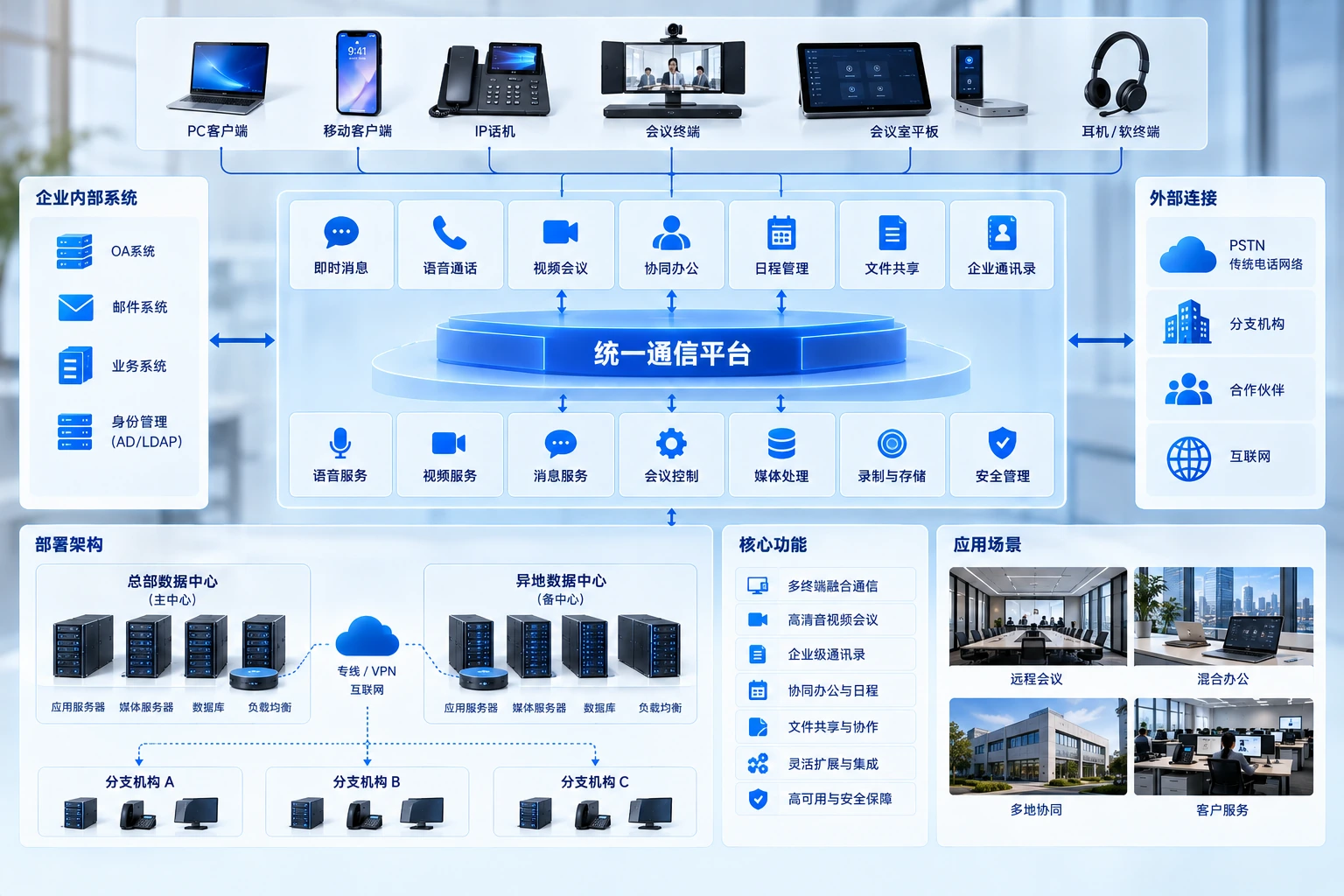
Desk phones, soft clients and meeting devices enter the IP access network first, where QoS and bandwidth admission carry them to the communications control platform. One side connects to the external-line boundary and the other to remote and branch sites; the platform handles registration and call setup, while voice and video follow their session paths.
Desk phones, soft clients and meeting devices connect to the IP access network and QoS, then to the communications control platform. The platform connects separately to the external-line boundary and remote or branch sites. Media sessions and control signaling are shown as separate relationships.
Keep the two relationships separate: Media sessions carry voice or video content; control signaling handles call and meeting state. They may use different paths and policies and need separate integration testing and validation.
03 Deployment and implementation services from Yuqi Intelligent
From current-state inventory to migration handover
Yuqi Intelligent keeps the communications platform, endpoints, network QoS, boundaries and user processes in one implementation scope, advancing by current state, compatibility and validation conditions.
Current-state inventory and communications boundaries
Inventory phones, soft clients, meeting devices, branch connections, number resources, existing platforms and network dependencies to define what to retain, replace or connect.
Solution design and compatibility assessment
Assess endpoint, platform, link, directory and legacy-system compatibility against organization, meeting, branch and migration goals, then define a verifiable implementation boundary.
Brand selection, quotation and equipment supply
Discuss brands and equipment forms around endpoint types, meeting spaces, boundary access, redundancy and maintenance, then support selection, quotation and supply.
Number routing and endpoint configuration
Organize numbers, dial plans, call routes, permissions, device registration, soft-client and meeting-endpoint configuration, keeping before-and-after change checks.
Network QoS and boundary integration
Check voice, video media-session and control-signaling paths separately, integrating the access network, QoS, bandwidth admission, firewall and external-line boundary.
Migration testing, training and operations handover
Plan migration validation, rollback conditions, user training and fault-handling boundaries by branch, number, endpoint and meeting scenario, leaving reusable documentation.
04 Client delivery
Hand communications relationships to operations and users
Delivery is more than bringing the platform online. The client also needs to know how to check numbers and routes, register endpoints, validate meetings, observe QoS and boundaries, and roll back migration. If the communications design also connects to enterprise system integration or servers and storage, the delivery documentation records dependencies and ownership.
- Unified communications current-state, endpoint, branch and boundary diagram
- Platform, endpoint, number-routing, dial-plan and permission configuration list
- Media-session, control-signaling, QoS, boundary and external-line integration record
- Branch migration sequence, meeting validation, rollback and change record
- Equipment selection, quotation and supply, compatibility decisions and asset records
- User training, fault procedures and maintenance ownership boundaries

05 Ongoing operations
Make communications changes traceable
After unified communications goes live, numbers, endpoints, certificates, boundaries, QoS, meeting policies and user permissions still need maintenance. Recording observation, change, rollback and training in the process keeps later expansion from depending on site memory.
Use the actual platform, endpoints, branch links and call and meeting tests confirmed by both parties as the implementation and acceptance basis.
Frequently asked questions
Clarify communications boundaries first
What does a unified communications architecture solve?
It puts telephony, soft clients, meeting devices, branch access, communications control, number routing and operating boundaries into one checkable relationship diagram, reducing configuration and migration blind spots. Results still depend on existing platforms, networks, links and business validation.
Why keep media sessions and control signaling separate?
Media sessions carry voice or video; control signaling establishes, changes and ends calls or meetings. They may use different network paths and policies and should not be treated as one piece of hardware or one serial link.
Can existing telephony and meeting equipment migrate directly?
Check equipment protocols, platform registration, number routing, directories, network QoS, boundary policy and rollback conditions first, then test by branch or scenario. Retention depends on compatibility and the migration scope confirmed by both parties.
What documentation remains after delivery?
It normally includes relationship diagrams, platform and endpoint configuration, number routing, meeting validation, QoS and boundary integration records, migration records, training material and maintenance boundaries. The actual list follows the project scope.
Start a discussion
Start with your telephony, meeting and branch plan
Tell us about current platforms, endpoints, number routes, branch links, meeting needs and migration windows so we can confirm the unified communications boundary.