
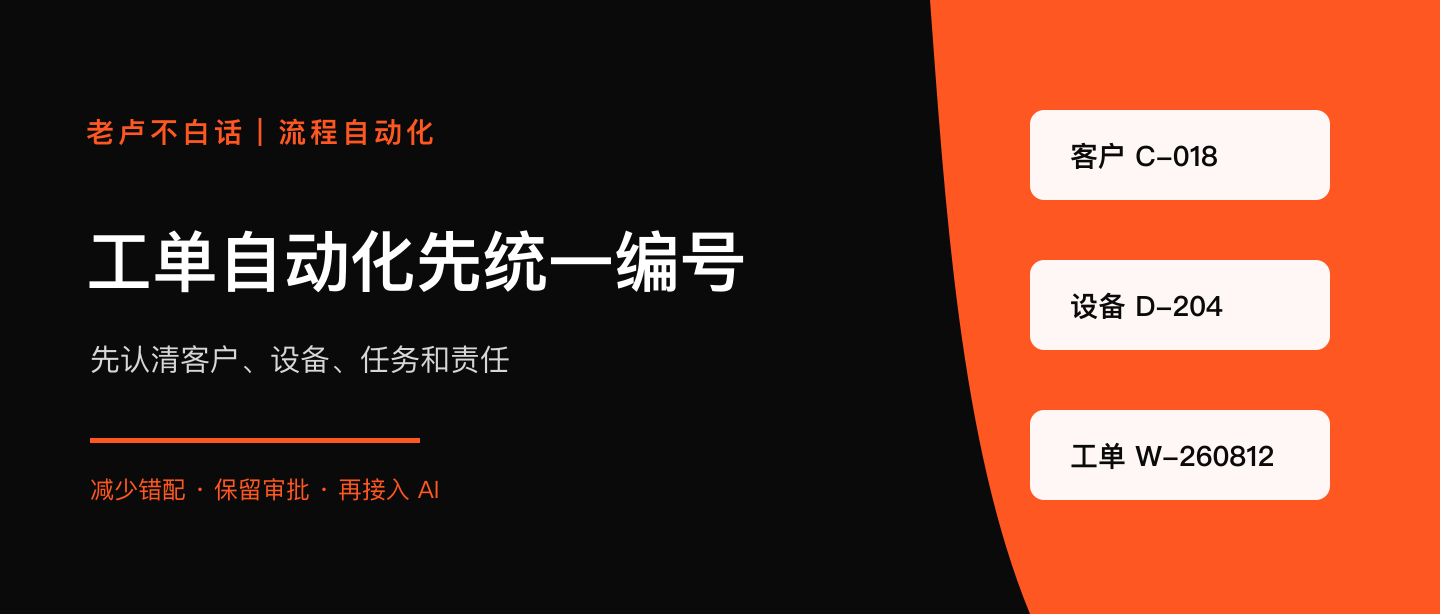
Reliable work order automation identifiers must connect each customer, asset, request, and owner across chat, email, spreadsheets, and the service platform. Without stable identifiers, automation can move records faster while repeating duplicate, mismatched, or incorrectly assigned work at scale.
Why work order automation identifiers fail across channels
A service request may begin in a chat message, continue by email, and end in a service platform. If the customer name, installed asset, contract, and original ticket are represented differently in each channel, automation cannot reliably decide whether to create, update, merge, or escalate a record. Faster data movement then produces faster duplication.
Where records split or merge incorrectly
- Trading names, legal names, and branch names are treated as different customers.
- Serial numbers, internal asset numbers, and service identifiers are mixed in one field.
- Replies create new tickets because the original work-order identifier is missing.
- Ownership is inferred from message text after staff, suppliers, or responsibilities change.
Use stable identifiers behind human-readable names
Establish four identifiers before adding AI: a customer identifier, an equipment or service identifier, a work-order identifier, and a responsibility identifier. Human-readable names can remain in the interface, but integrations should use stable identifiers to join records and to distinguish a new request from an update to an existing case.
Define the authority for each identifier
- Which system creates the customer identifier and resolves duplicates?
- How are assets, subscriptions, and service locations related to a customer?
- When does a conversation become a new work order instead of an update?
- Which team or person owns assignment, approval, closure, and reopened cases?
Keep the source and every automated decision together
Define which system creates each identifier, who may merge duplicates, and how historical records are mapped. When AI extracts a request, keep the original message, extracted fields, confidence or exception state, assigned owner, and approval result. High-impact actions such as closing a case, changing entitlement, or notifying a customer should remain reviewable.
Pilot the workflow without losing accountability
- List every channel that creates or updates a service request.
- Choose one authoritative customer and asset record.
- Generate a unique work-order number before downstream automation.
- Route ambiguous ownership or duplicate matches to a person.
- Measure exceptions and corrections, not only processing speed.
Questions before connecting service channels
Can AI create the identifiers?
AI can extract candidate fields, but the authoritative identifier should come from a controlled customer, asset, or service system with duplicate and exception rules.
What should happen when confidence is low?
The workflow should stop automatic posting and route the source message, candidate matches, and reason for uncertainty to a named reviewer.
How should success be measured?
Measure duplicate rates, incorrect matches, corrections, reopened cases, ownership delays, and customer impact in addition to processing speed.
Place work orders inside the wider service model
Reliable identifiers connect customer communication to assets, responsibilities, approvals, and operating records. That foundation should be designed before adding more automation channels.