
Network security / internal controls
Internal Network Security & Access Control
Securing only the exit does not answer internal access questions. Put identity, endpoint state, admission, segmentation, resource authorisation and log response on one reviewable control chain to know who accesses what under which conditions.
Give identity, endpoints and resource access a clear management boundary.
01 Why internal security controls matter
Internal access cannot rely on one boundary
Employee computers, guest devices, printers, servers and building endpoints may share an enterprise network. An edge firewall controls the boundary but cannot by itself show whether internal access meets identity, device and business conditions.
Align objects, zones, resources and ownership before deciding admission, segmentation, authorisation and audit. Then policy has a place to land and incidents have a path back to the site.
Internal access exists beyond the edge
An edge firewall can guard the external boundary but cannot alone explain whether internal access among employees, guests, printers and servers is appropriate.
Identity and endpoint state must be judged together
Authentication confirms who; endpoint state shows which device is used and whether it meets conditions. Neither replaces authorisation.
Segmentation policy must reach business resources
Office, server, management, guest and special endpoints need explainable zone boundaries before deciding whether to allow, isolate, alert or make an exception.
Incidents must remain reviewable and actionable
Correlate users, endpoints, IPs, resources, actions, time and policy results to support investigation, rollback and adjustment.
02 Identity, endpoints and access relationships
Make internal access orderly and controllable
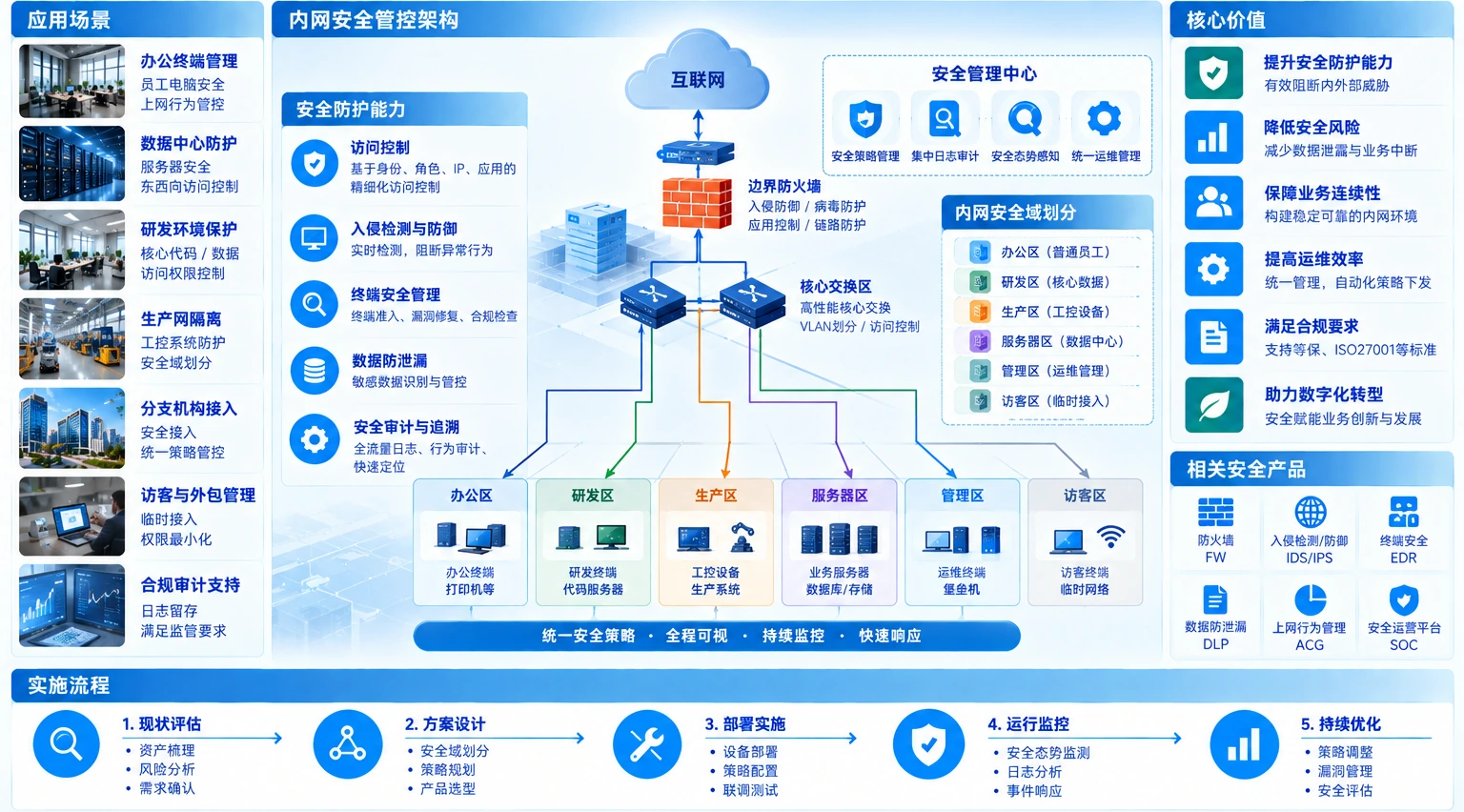
Authentication identifies the subject and endpoint state supplies access conditions. Admission and segmentation policy define the access boundary, while resource authorisation defines what can be done. The policy console maintains rules, exceptions and changes separately, with reviewable logs and response records.
Users and endpoints enter identity and endpoint-state assessment, then reach authorised business resources through admission and network zones. The policy console separately connects identity, segmentation and log handling.
03 How Yuqi Intelligent participates
What Yuqi Intelligent can deliver
Put current-state review, equipment and software selection, deployment, pilot and handover in one implementation scope, validating real users, endpoints, zones and resources step by step.
Current-state review and asset scope
Map users, endpoints, software, network zones, critical resources, existing policy and log sources, then confirm which objects are in scope.
Equipment and software selection and supply
Use identity sources, endpoint types, switching, management platforms and maintenance conditions to support equipment and software selection, quotation and supply.
Admission, segmentation and access policy
Turn identity, endpoint state, zones, resources, peripherals and exceptions into an executable policy matrix with clear change ownership.
Policy deployment and system integration
Connect platform, network, endpoints, directories, logs and alerts in configuration, then validate the actual relationship among authentication, authorisation and policy matches.
Pilot, observe and roll back
Pilot with representative zones, users and endpoints, observe business access, isolation, exceptions and alerts, then expand under confirmed conditions.
Testing, training and agreed maintenance
Deliver test records, operational training, incident paths and maintenance boundaries, then support later policy changes and operational review as agreed.
04 Client delivery
Hand the security boundary to operations and business owners
Delivery is more than an authentication or policy platform. The client needs the asset scope, policy matrix, exceptions, authorised resources, test results and incident-response boundary. When network entrances also need review, connect to Identity & Access Management Platform and Next-generation firewall, putting each control plane back within its own ownership.
- Asset scope for users, endpoints, software, network zones and critical resources
- Policy matrix for identity, endpoint admission, segmentation, authorised access and exceptions
- Authentication, authorisation, isolation, logs, alerts and rollback test records
- Administrator actions, incident response, training and agreed maintenance handover records

05 Frequently asked questions
Define the internal-control boundary first
How do internal security controls differ from a boundary firewall?
A boundary firewall handles exits, entries and traffic boundaries. Internal security controls also relate identity, endpoint state, internal zones, resource authorisation and behaviour logs. Their responsibilities differ and should be checked together against the actual boundary.
Does successful authentication always grant resource access?
Not necessarily. Authentication confirms the subject; authorisation also considers endpoint state, network zone, resource, time, business need and policy result. Detection is not an all-purpose block.
How can policy go-live reduce impact on office work?
Create an asset and business-access baseline, pilot a representative zone, retain exceptions, observation and rollback conditions, then expand policy from test results.
Start a discussion
Start with existing assets and access relationships
Tell us about users, endpoints, critical resources, network zones, existing security equipment and maintenance windows so we can define review, pilot, testing and handover boundaries.